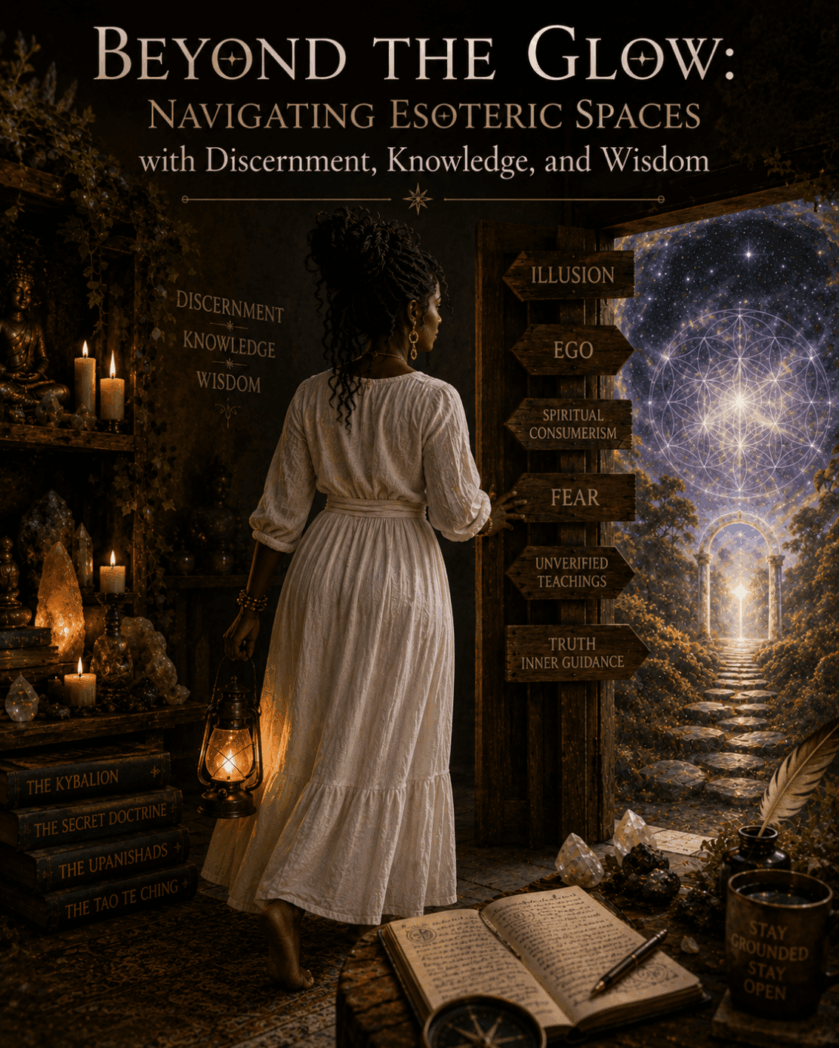
Beyond the Glow: Navigating Esoteric Spaces with Discernment, Knowledge, and Wisdom
Beyond the Glow: Navigating Esoteric Spaces with Discernment, Knowledge, and Wisdom
There is a particular kind of magic in stepping into an esoteric space for the first time. Whether it is a dimly lit occult bookshop, a virtual forum discussing Hermeticism, or a weekend workshop on energy healing, the atmosphere hums with possibility. It’s felt immediately. One may feel that there is a promise of secret truths. Perhaps, a key to a unlock rooms with secret knowledge.
However, these spaces are not just repositories of ancient wisdom. They are also ecosystems of personality, tradition, speculation, and sometimes, sincere delusion. To walk through them safely, you need more than curiosity. You need three distinct tools: discernment, knowledge, and wisdom. They are not the same thing. And confusing them is the first mistake many seekers make.
Discernment: The Inner Gatekeeper
Discernment is often mistaken for skepticism, but that is too harsh a word. Skepticism closes doors. Discernment tests the hinges before walking through.
In esoteric spaces, discernment is your ability to feel the difference between a teaching that resonates with truth and one that merely flatters your ego. It is the quiet alarm that sounds when a self-proclaimed guru asks for total loyalty or when a ritual promises instant enlightenment for a fee.
Discernment operates in the body as much as the mind. A clenched stomach, a sudden heaviness, a sense of performative awe. These are signals. Learn to trust them. Discernment asks simple but powerful questions: Does this teaching empower me or make me dependent? Does it invite inquiry or demand obedience? Does it acknowledge mystery or pretend to have all the answers?
Without discernment, you will collect spiritual trinkets. Crystals, titles, initiations, secret names. But you will not transform. You will simply redecorate your cage.
Knowledge: The Map, Not the Territory
Knowledge is what you can read, memorize, and recite. It is the historical origin of the Tarot. The correspondences of the planets. The steps of a ritual. The difference between Rosemary and Basil. Knowledge is essential. It gives you a vocabulary. It prevents you from reinventing the wheel or falling for basic misinformation.
But knowledge has a shadow. In esoteric spaces, it is easy to mistake erudition for elevation. You will meet people who can quote obscure grimoires from memory but have never put anything in practice. Knowledge without humility becomes a type of spiritual materialism. I have an impressive collection of artifacts and tools are artifact. They must put in practice, test, question and side-eye. It is a lived experience of practice and use.
The key is to treat knowledge as a living library, not a showpiece. Read widely across traditions, but read critically. Notice where sources agree and where they contradict. Understand that a text from 16th century Europe carries cultural baggage, not universal truth. Knowledge is your compass, but it does not walk the path for you.
Wisdom: The Slow Bloom
Wisdom is what remains after discernment and knowledge have done their work. It cannot be bought, downloaded, or even conferred in an initiation ceremony. Wisdom is the slow accumulation of lived experience, integrated over time.
In the elder who does not claim to know the secrets of the universe but can sit with you in your confusion without rushing to fix it. Wisdom is the ability to hold paradox. That a spell can work through psychological alignment or external forces, and both explanations might be true depending on the moment. 💯👩🏾🍳That a tradition can be beautiful and also flawed. That you can outgrow a path without burning it down for others.
Where the Three Meet
The most dangerous person in an esoteric space is not the obvious charlatan. It is the one with knowledge but no discernment, or discernment without wisdom. The former becomes a dogmatist. The latter becomes a paranoid who sees deception everywhere and in everything.
The healthiest seeker cultivates all three in balance. Discernment filters what you allow in. Knowledge builds a reliable internal structure. Wisdom teaches you when to hold a teaching lightly and when to let it go completely.
Practical steps for the beginner or the returning traveler:
- Pause before pledging. Any group or teacher that demands immediate secrecy or loyalty without a trial period is a red flag. Real esoteric work respects your autonomy.
- Keep a discernment journal. After a ritual, a reading, or a class, write down what you felt in your body and what questions remain. Not just what you learned.
- Study outside your lineage. A Thelemite who understands Catholic mysticism is wiser. An iyanifa who knows Buddhist philosophy has deeper discernment. Cross training prevents cultish thinking.
- Honor your no. If something feels wrong even when everyone else is ecstatic, honor that. Discernment often whispers before it shouts.
- Welcome uncertainty. Wisdom often arrives as a question mark, not an exclamation point.
The Quiet Reward
Esoteric spaces at their best are not about acquiring power or secret titles. They are about remembering something you already know. That reality is stranger and more beautiful than the artifact collector story allows. That you are both insignificant and sacred. That the path is long, and there is no finish line, only deepening.
But to walk that path without falling into traps of ego, fantasy, or manipulation, you need discernment as your lantern, knowledge as your staff, and wisdom as your pace. Go slowly. Ask hard questions. Trust your unease. And never mistake a polished performance for genuine depth.
The real mysteries do not need to sell themselves. They wait, patient as stone, for those who approach with open eyes and a humble heart.
Thanks for reading.
Always dig deeper.
Tam
Share this content:


Post Comment
You must be logged in to post a comment.